The Hybrid Office Under UK Conditions: Six Books Tested Against Commutes, Childcare and Team Trust

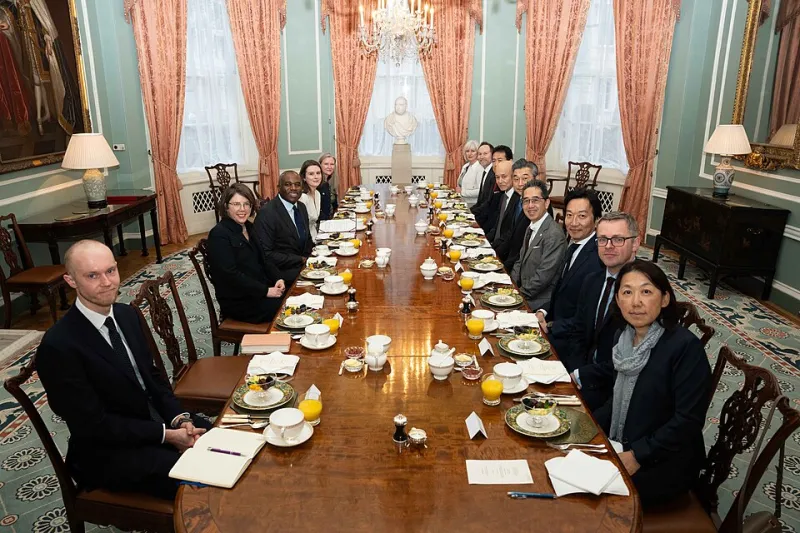
Photo: David Dixon , CC BY-SA 2.0, via Wikimedia Commons
Hybrid-work books tend to arrive with a confident tone. They describe the office as a destination, the home as a workspace and the manager as a designer of culture. That language can be useful. It can also glide past the practical details that decide whether a 2026 attendance policy works in the UK: the 07:42 train that is cancelled, the 15:15 school pickup, the spare room that is also the kitchen table and the team member who believes visibility still matters more than output.
This review looks at six widely read books on remote, hybrid and office work and asks a simple question: what survives contact with a UK manager's week? The six are Out of Office by Charlie Warzel and Anne Helen Petersen, Remote: Office Not Required by Jason Fried and David Heinemeier Hansson, The Nowhere Office by Julia Hobsbawm, Redesigning Work by Lynda Gratton, Remote Work Revolution by Tsedal Neeley and Office Shock by Bob Johansen, Joseph Press and Christine Bullen. They are not interchangeable. Some are stronger on team practice; others are stronger on policy design. Several carry assumptions that travel badly across the Atlantic.
What the books get right
The strongest common argument is that location should follow the work. Remote Work Revolution is particularly useful on team operating rules: what gets documented, how decisions are recorded and when synchronous time is genuinely needed. Redesigning Work is stronger on the design question. It asks managers to treat work as a system of tasks, roles and locations rather than a binary choice between home and office.
The Nowhere Office is the most UK-literate of the six. It recognises that the office has lost its default status and that managers now need to justify attendance. Out of Office is useful on the employee experience of home working, especially the blur between work and domestic life. Office Shock offers scenario thinking rather than prescriptions, which is helpful for managers who are tired of being told there is one correct model.
Remote: Office Not Required remains a readable polemic. Its best contribution is the case against default presenteeism and the argument for asynchronous work. Its weakness is that it was written as a manifesto for a particular kind of software company. That context matters.
Where the assumptions break
The first break is the commute. Several books treat commuting as a cost to be optimised. A UK manager knows it is also a reliability problem. Rail delays, tube disruptions, bus cancellations and the cost of flexible tickets all affect whether an attendance day is productive or merely performed. A policy that requires three days a week in the office may look reasonable in a book. It looks different when one of those days begins with a cancelled service and a 90-minute delay.
The second break is childcare. US-centric books often discuss school pickups in general terms. UK managers face a specific pattern: school hours that end in the mid-afternoon, wraparound care that must be booked in advance and holiday periods that do not align neatly with annual leave. An attendance policy that ignores the 15:15 pickup will disproportionately affect parents and carers, often women. That is not a side issue. It is a design flaw.
The third break is housing. The assumption of a quiet room with a door is not universal. Many UK employees work in flats, shared houses or homes where the kitchen table doubles as a desk. Books that celebrate the home office can sound aspirational to managers who know that some team members are taking calls from a bedroom. The practical response is not to demand a return to the office. It is to design work that does not depend on uninterrupted video calls all day.
The fourth break is trust. Hybrid books often present trust as a cultural attitude. In practice, trust is built through predictable behaviour: clear decision rights, reliable handovers and managers who do not equate presence with commitment. Remote Work Revolution and Redesigning Work are useful here because they focus on operating rules rather than slogans. Remote: Office Not Required is less useful for a manager who needs to rebuild trust across a mixed team, because its tone can read as a rejection of the office rather than a redesign of it.
The 2026 policy question
As organisations finalise attendance policies for 2026, the useful reading order is not the same as the bestseller order. Start with The Nowhere Office for UK context. Read Redesigning Work for a framework that connects tasks, roles and locations. Use Remote Work Revolution for team-level operating rules. Read Out of Office for the employee experience, especially the domestic realities that policies often ignore. Use Office Shock for scenario planning with senior stakeholders. Treat Remote: Office Not Required as a historical argument rather than a policy manual.
A practical test for any hybrid book is whether it can answer three questions. The commute test: does the policy assume a reliable journey that many employees do not have? The care test: does it account for school hours, caring responsibilities and the cost of wraparound care? The trust test: does it create clear rules for decisions and handovers, or does it rely on managers to be present and hope for the best?
A shortlist for the UK manager
For a manager navigating a 2026 attendance policy, the most practical shortlist is The Nowhere Office, Redesigning Work, Remote Work Revolution and Out of Office. Read them in that order. The first explains the shift, the second gives a design method, the third offers team rules and the fourth keeps the employee experience in view. Office Shock is a useful addition for senior managers who need to think beyond the next policy cycle. Remote: Office Not Required is worth reading for its challenge to presenteeism, but it should not be treated as a template for a UK organisation.
The broader lesson is that hybrid-work books are most useful when they are read as arguments to be tested, not instructions to be followed. A UK manager needs frameworks that can survive a delayed train, a school pickup and a team that disagrees about what the office is for. The best books on this list help with that test. The weakest assume the test does not exist.